

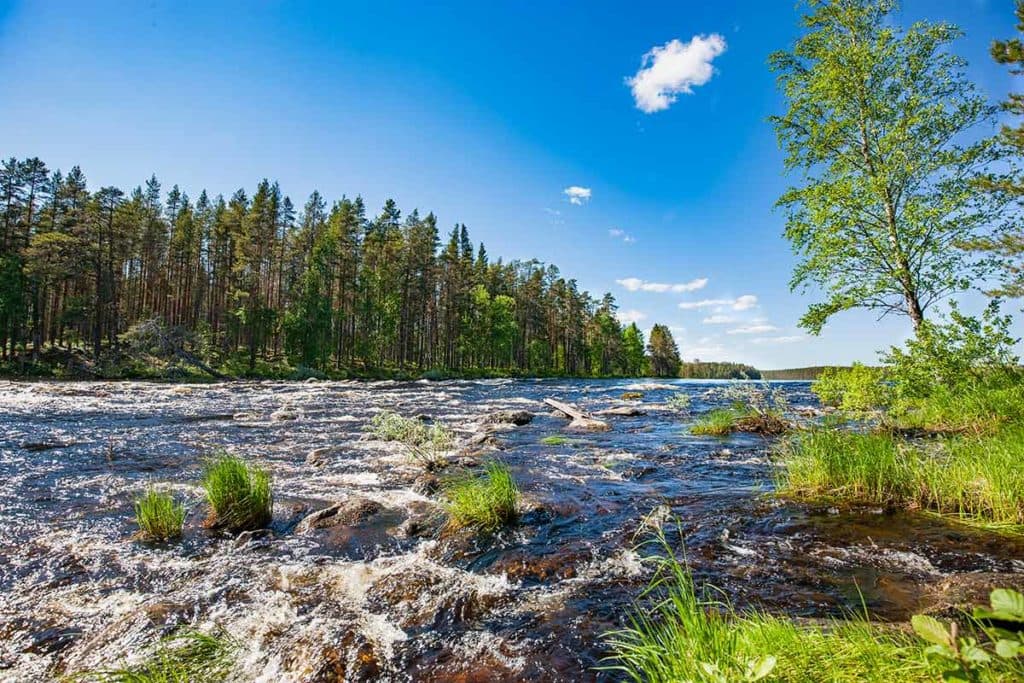
Kattilakoski, Torneälven
Kattilakoski is a salmon migration monitoring site on Torneälven, also known as Tornionjoki on the Finnish side. Salmon and other migrating fish are counted with sonar at Kattilakoski, about 100 km upstream from the river mouth. For anglers, this makes Kattilakoski a key migration signal when following the Torne River season. The data should be used together with water conditions, regulations and local reports, not as a direct forecast of fishing success.
Quick facts


How to read the historical migration charts
These charts show recorded salmon migration at Kattilakoski across available seasons. They help compare years, identify the main migration window and see whether the current season is early, late or close to average.
Treat the charts as data from one fixed monitoring area, not as a complete picture of fishing quality across the whole Torne River system. The annual chart can show whether a season had a higher or lower recorded count, but it should be read with care when comparing years with different water conditions, monitoring conditions or later-reviewed estimates.
A cumulative chart can show how quickly salmon moved past Kattilakoski during the season. A weekly or daily chart helps identify when movement builds, peaks and slows down. The clearest picture comes when migration data is compared with current water level, temperature, regulations and fresh reports from the part of the river you plan to fish.
Where the counter is and why location matters
Kattilakoski is located about 100 km upstream from the mouth of Torneälven / Tornionjoki. This position matters because salmon recorded there have already entered the river and moved through the lower part of the system before reaching the monitoring area.
Torneälven is a large border river system, so one monitoring point does not describe every fishing area. A count at Kattilakoski gives a strong signal for the main salmon run, but it does not tell you what is happening in every pool, tributary or upper section. For anglers, the key question is how the stretch they plan to fish relates to Kattilakoski and to the timing of the run.
How the fish counter works
Kattilakoski uses sonar-based monitoring rather than a fishway counter. This matters because Torneälven is a large natural river, not a small controlled passage. A hydroacoustic method, often described as horizontal sonar, is used to count fish moving through the monitoring area.
- Fish move through the monitored river section.
- Sonar units detect movement in the water.
- The system records passage through the monitoring area.
- Data is analysed to estimate the number of ascending salmon.
- Results are used for seasonal monitoring and stock assessment.
This type of data is useful because it can monitor migration in a large river environment. It should still be read as a monitoring estimate from one defined site, not as a direct picture of fishing success on a specific stretch. Final salmon run estimates may be updated after all monitoring data has been analysed.
What the monitoring data can and cannot tell you
Use Kattilakoski data as a migration signal, not as a fishing forecast. The data can show whether salmon are moving past Kattilakoski, how active the recent migration period has been, and whether the season is starting to build. It can also help compare the current run with earlier years and recent reports.
The counter does not tell you whether salmon are taking flies or lures. It does not show exactly where fish are holding, which pool is best today, or how much angling pressure there is on a specific stretch. A high count can be useful, but it does not automatically mean that every part of Torneälven is worth fishing.
For trip planning, the strongest signal comes when several things line up: movement past Kattilakoski, suitable water conditions, clear regulations and recent reports from the section you want to fish. If only one signal looks good, treat the data with more caution.