Torneälven
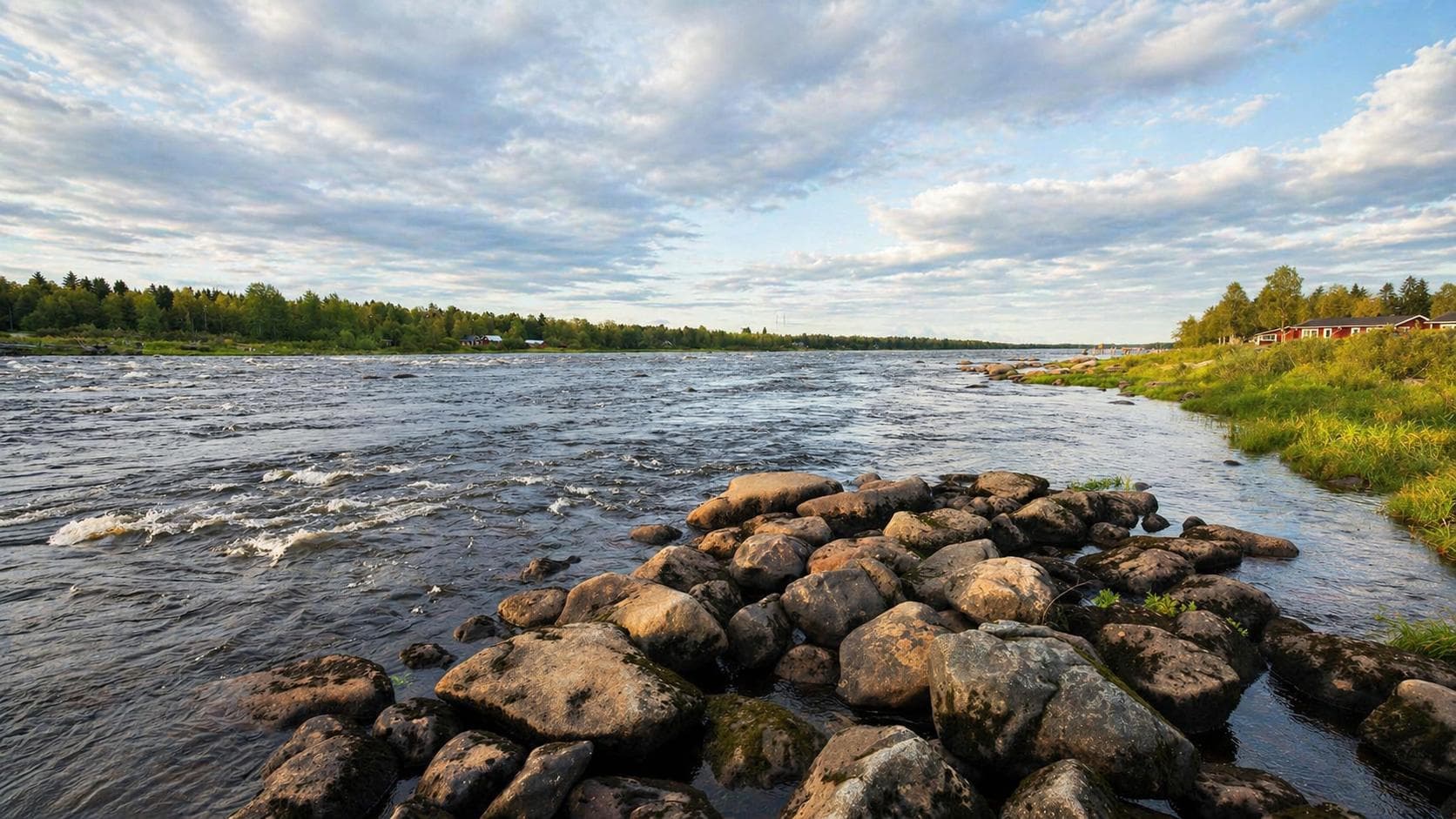
Torneälven / Tornionjoki is one of northern Europe’s major Baltic salmon rivers. It forms part of the Sweden–Finland border system and is managed under transboundary fishing rules.
The joint permit area covers Tornionjoki, Muonionjoki and Könkämäeno, with local rules, restricted periods and different fishing methods depending on the water.
Torneälven has a major salmon-monitoring point at Kattilakoski, about 100 km upstream from the river mouth. Salmon and other migratory fish are counted there with sonar from mid-May to at least the end of August.
The river is known for large Baltic salmon. Local and operator information describes average salmon weights around 6–8 kg on some waters, with the largest fish of the season often over 20 kg. These are local / operator figures, not a guaranteed river-wide average.
Quick facts
- country: Sweden / Finland
- river name: Torneälven / Tornionjoki
- river type: large border salmon river
- main species: Atlantic salmon
- other species: grayling, trout, sea trout, pike, perch, whitefish, ide, burbot and roach in some local waters
- key permit system: Tornionjoki–Muonionjoki–Könkämäeno joint permit
- 2026 salmon season: 8 June at 19:00 Finnish time to 15 August
- restricted salmon fishing: until 25 August
- weekly salmon closure: Sunday 19:00 to Monday 19:00 Finnish time / Sunday 18:00 to Monday 18:00 Swedish time
- 2026 salmon quota: maximum 2 salmon per angler per season
- monitoring: Kattilakoski sonar counter, about 100 km upstream from the mouth
- main checks: joint permit, local water, weekly closure, quota, restricted late-season rules, Kattilakoski data
Season and key rules
In the 2026 joint permit area, salmon fishing begins on 8 June at 19:00 Finnish time and continues until 15 August. After that, salmon fishing is allowed with restrictions until 25 August.
There is a weekly 24-hour salmon protection period. Salmon fishing is prohibited from Sunday 19:00 to Monday 19:00 Finnish time, or Sunday 18:00 to Monday 18:00 Swedish time.
During the 2026 season, each angler may take a maximum of 2 salmon. After that, salmon fishing must stop completely.
Permit sales may be stopped during the season if fish stocks or conditions require it.
A joint permit is needed for lure fishing in the border river and in the area covered by the fishing regulations. On the Finnish side, hook-and-line fishing and ice fishing are fully prohibited in running and rapid sections of waters with migratory fish stocks.
River character and access
In the joint permit area, allowed methods include spinning / casting, fly fishing, hook-and-line fishing and trolling, subject to local rules and restrictions.
In many places, salmon fishing is not limited to the bank. Finnish fishing information describes salmon and sea-trout fishing with trolling plugs from rowing boats, bank fishing in some areas and fly fishing on rapid sections.
Private and organised beats can fish very differently from open local waters. Kengis Bruk is a private salmon beat on Torneälven with about 3 km of water, three fishing zones, a maximum of 6 rods per week, shelters and fireplaces in each zone, and a lodge season from 1 June to 31 August.
Water level changes the fishing at Kengis. In Zone 2 / Island Pool, high water is fished from the bank, and Island Pool can be difficult in very high water. Island Pool and Boat Pool are described as fishable in the traditional way down to about 350 m³/s. Around 200 m³/s, the approach changes again.
Fisheries, stretches and permits
Tornionjoki–Muonionjoki–Könkämäeno joint permit covers the main border-river permit area. Area-specific permits are also available for anglers who want to fish only one part of the system.
Kattilakoski is the main monitoring point. It gives migration data from one fixed site, not a catch forecast for every pool or beat.
Junosuando FVO lists Torne River and Tärendö River in its waters. Local species include perch, pike, grayling, brown trout, sea trout, salmon, whitefish, ide and burbot.
Kengis Bruk is a private salmon beat with 3 km of water, three zones and named fishing points. It is a good example of structured fly-fishing water on Torneälven, but it does not describe the whole river.
Rules that change the trip
2026 salmon season and restricted late period
Salmon fishing in the joint permit area begins on 8 June at 19:00 Finnish time and continues until 15 August. Restricted salmon fishing continues until 25 August.
Weekly salmon closure
Salmon fishing is closed every week from Sunday 19:00 to Monday 19:00 Finnish time, or Sunday 18:00 to Monday 18:00 Swedish time.
Two-salmon season quota
In 2026, each angler may take a maximum of 2 salmon. After that, salmon fishing must stop completely.
Permit sales can stop
Permit sales may be stopped during the season if fish stocks or conditions require it.
Finnish-side rapid restrictions
On the Finnish side, hook-and-line fishing and ice fishing are fully prohibited in running and rapid sections of waters with migratory fish stocks.
Kattilakoski is migration data
Kattilakoski counts salmon and other migratory fish with sonar about 100 km upstream from the river mouth. It is a migration signal, not a pool-level catch forecast.
Target species
Atlantic salmon is the main species for this profile. Torneälven / Tornionjoki is one of the major Baltic salmon rivers, with annual salmon monitoring at Kattilakoski and strict season rules.
Grayling and trout matter in local and tributary waters. Junosuando FVO lists grayling and brown trout, and local waters can differ strongly from the main salmon-focused border river.
Pike, perch, whitefish, ide, burbot and roach are relevant in mixed local waters. They should not be confused with the main salmon-fishing profile of the border river.
Large Baltic salmon are part of the river’s reputation. Kengis Bruk lists an average salmon size of 15–18 lb / 6.8–8.1 kg on its private water, and Naamisuvanto describes recent Tornio River average salmon weights around 6–8 kg, with the largest salmon of the season often over 20 kg. These are local / operator figures, not a guaranteed river-wide average.
Kattilakoski sonar counter
Kattilakoski is the key migration-monitoring point for Torneälven / Tornionjoki. Salmon and other migratory fish are counted there with sonar, about 100 km upstream from the river mouth.
The monitoring site is about 180 m wide. Two sonar units are used, one on each bank, with guiding fences narrowing the monitored channel.
Monitoring starts annually in mid-May and continues at least until the end of August. Results are preliminary during the season. Final estimates are available in early winter after the datasets have been analysed.
What to watch
- Kattilakoski sonar — main migration signal, about 100 km upstream from the mouth.
- 2026 salmon start — 8 June at 19:00 Finnish time.
- Weekly closure — Sunday evening to Monday evening.
- Time difference — Finnish and Swedish times differ by one hour.
- Season quota — maximum 2 salmon per angler in 2026.
- Restricted late period — salmon fishing continues with restrictions until 25 August.
- Permit sales — can stop if fish stocks or conditions require it.
- Method by area — boat trolling / rowing, spinning and fly fishing all matter.
- Private beats — Kengis-style water should not be used as a model for the whole river.
- Large salmon — fish over 20 kg are part of the river’s reputation, not a guarantee.
What can go wrong
- You plan salmon fishing during the weekly protection period.
- You miss the one-hour difference between Finnish and Swedish time.
- You assume Kattilakoski predicts catches in your exact pool.
- You take 2 salmon and continue salmon fishing, although fishing must stop after the season quota is reached.
- You plan late August fishing without checking the restricted-period rules.
- You buy the wrong permit for the water you plan to fish.
- You treat the whole river as fly-only, although boat trolling, rowing methods and spinning are important in many areas.
- You use Kengis Bruk descriptions as if they described the whole river.
- You fish Finnish-side running / rapid water with a method that is not allowed there.
FAQ about Torneälven
For this profile, yes. Torneälven / Tornionjoki is one of the major Baltic salmon rivers. Local waters also hold grayling, trout, pike, perch, whitefish, ide, burbot and roach.
 Articles