

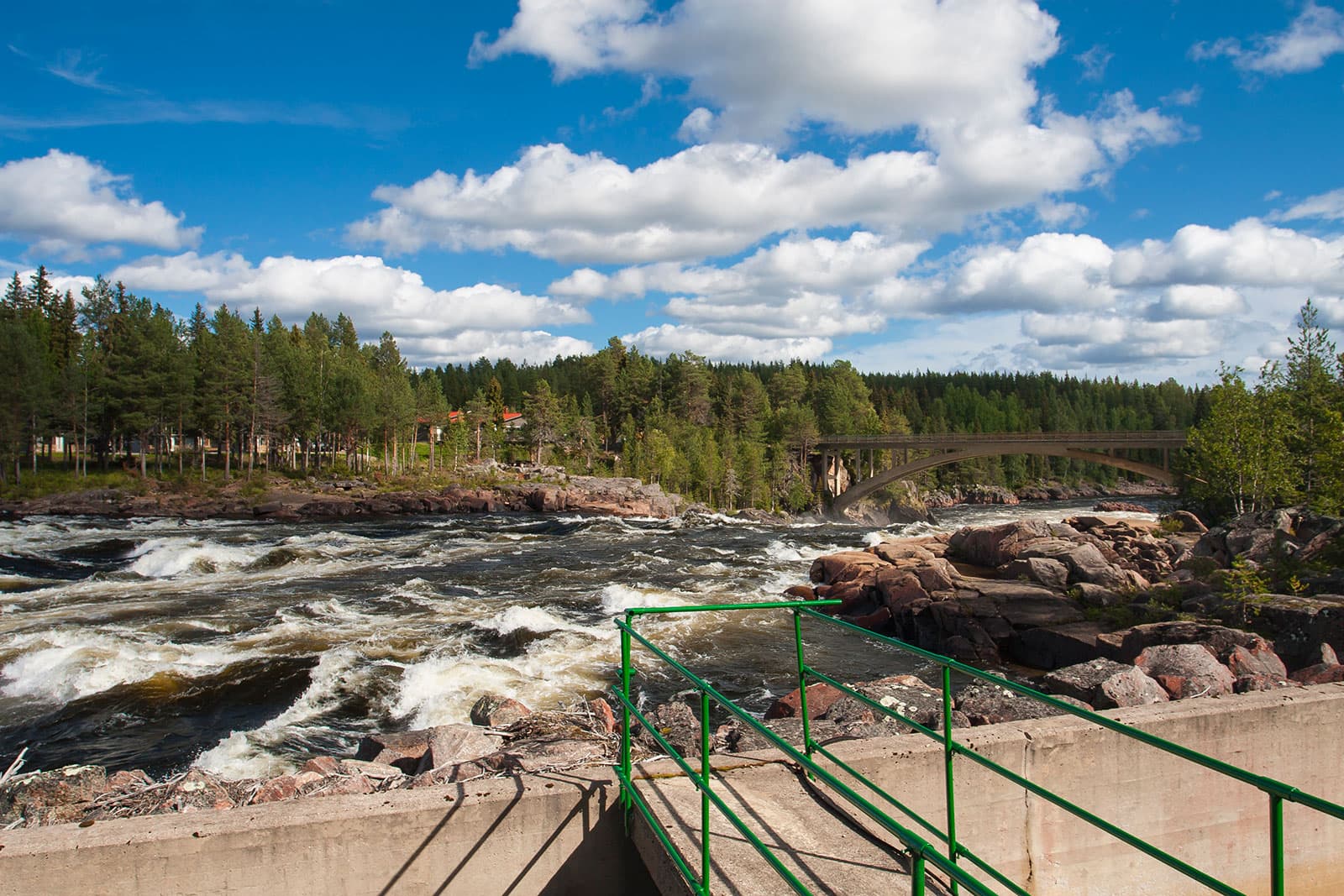
Jockfall, Kalixälven
Jockfall is a fish counter on Kalixälven, located in the fishway at Jockfall, about 100 km upstream from the river mouth. The fall is about 9 m high and was historically a partial migration barrier for salmon and trout. A fishway was built in 1980 to help fish pass the fall and reach spawning areas upstream. For anglers, Jockfall provides a migration signal from one of the key passages in Kalixälven. The data should be read together with river conditions, local reports and the stretch you plan to fish, not as a direct forecast of fishing success.
Quick facts


How to read the historical migration charts
These charts show recorded migration at Jockfall across the available seasons in this dataset. They can help compare years, identify the main migration window and show how movement through the fishway changed between seasons.
Treat the charts as data from one fixed passage, not as a complete picture of fishing quality across Kalixälven. The annual chart can show whether a season had a higher or lower recorded count, but it should be read with care if the counter was not active for the full season or if records were later corrected.
A cumulative chart can show how quickly fish moved through Jockfall during the season. A weekly or monthly chart helps identify when movement builds, peaks and slows down. The clearest picture comes when migration data is compared with current water conditions, local reports and the part of Kalixälven you plan to fish.
Where the counter is and why location matters
The counter is located in the fishway at Jockfall, about 100 km upstream from the mouth of Kalixälven. This position matters because Jockfall was historically a partial barrier for salmon migration, and much of the river’s salmon reproduction area lies upstream of the fall.
A fish recorded at Jockfall has already entered Kalixälven and moved through the lower river before reaching the fishway. The count does not describe every pool or fishing area, but it gives a signal from one defined migration passage. For anglers, that distinction matters when comparing Jockfall data with reports from lower or upper sections.
Jockfall is also linked with notable size records. Archived records mention a salmon of about 140 cm registered at Jockfall in 2008, while current public information notes that the largest registered salmon there have been around 145 cm.
How the fish counter works
The Jockfall counter is described as an electronic fish counter with video recording in the fishway. When fish pass through the counter, different species can be separated using image and video. The system also records fish length, passage time and passage direction.
- Fish pass through the Jockfall fishway.
- The electronic counter records the passage.
- Image and video help separate species.
- Fish length, time and direction are registered.
- The records can be used to follow migration through Jockfall.
This means the data is useful for understanding movement through the fishway, but it should still be treated as a monitoring record from one fixed point. It does not show where fish are holding, whether salmon are taking flies or lures, or whether conditions are suitable on a specific stretch.
How to use current and historical data
Use Jockfall data as a migration signal, not as a fishing forecast. Current public counts can help show whether fish are passing through the fishway now, while historical records help compare the timing and strength of different seasons.
For trip planning, the strongest signal comes when several things line up: movement through Jockfall, suitable water level, stable or improving temperature, and recent reports from the section you want to fish. Historical data can describe past migration patterns, but it should not replace current river conditions, local rules or fresh catch reports.