

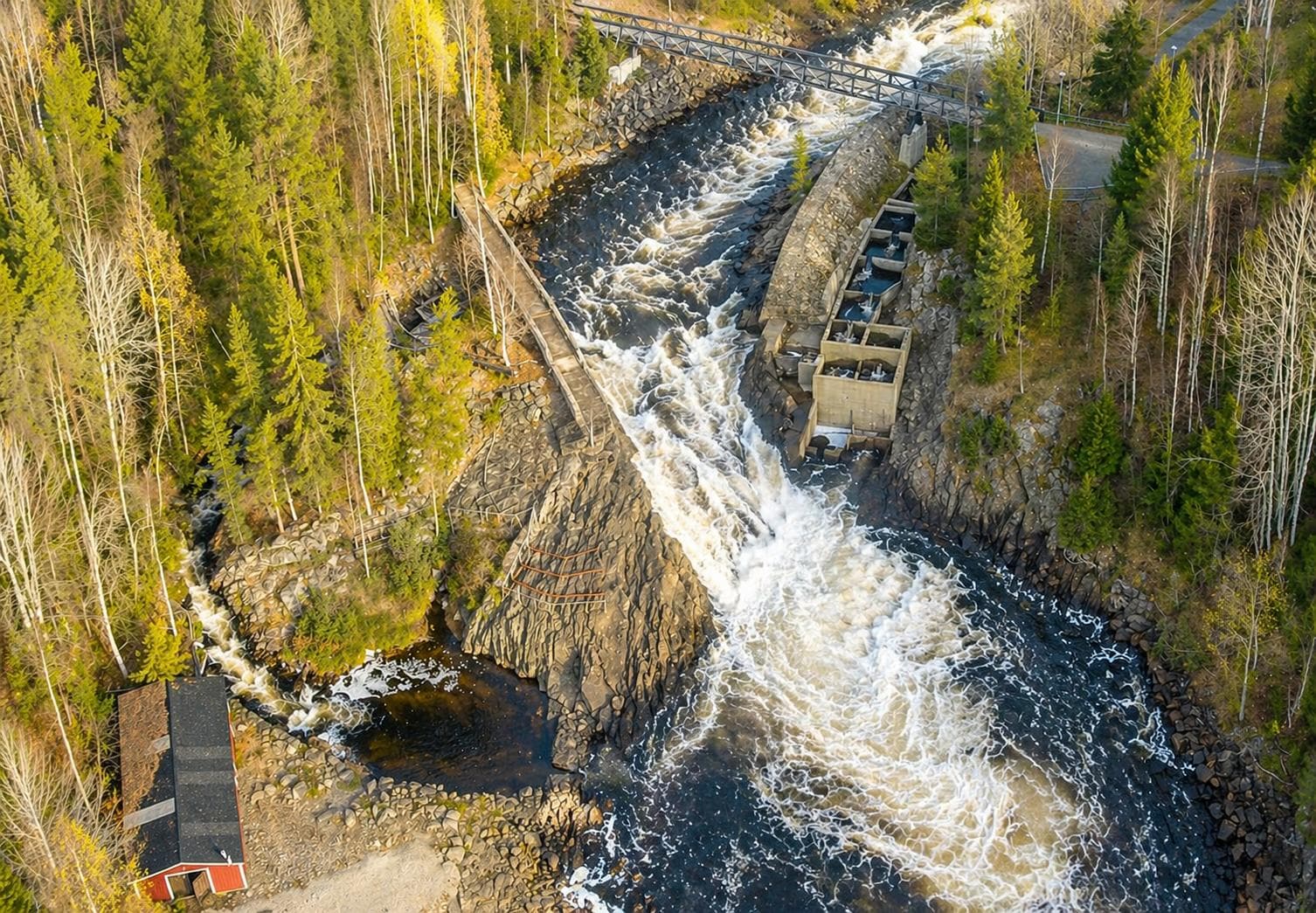
Fällfors, Byskeälven
Fällfors is a fish counter on Byskeälven that monitors salmon and trout as they move through the river system. It is located about 28 km upstream from the sea, so the data reflects fish that have already passed the lowest part of the river. For anglers, the counter is useful because it shows whether fish are moving, how the season is developing, and how current activity fits the wider migration pattern. It should be read together with water level, temperature and catch reports, not as a direct forecast of fishing success.
Quick facts


How to read the historical migration charts
The charts show recorded migration at this monitoring point across available seasons. They help compare years, identify the main migration window and see whether the current season is early, late or close to average. Treat them as data from one fixed point, not as a complete picture of fishing quality across the river.
The annual chart compares the strength of different seasons at Fällfors. It can show whether a year had a high or low recorded count, but it should be read with care if the counter was not active for the full season, the data source changed, or some records were later corrected. The cumulative curve shows how quickly fish moved through the counter during the season.
A weekly or monthly chart helps identify the main migration window. For anglers, this is often more useful than one daily number, because it shows when movement builds, peaks and slows down. The best reading comes when historical migration is compared with current water level, temperature and fresh reports from the sections you plan to fish.
Historic totals
Where the counter is and why location matters
The Fällfors fish counter is positioned in the lower part of the river system, although not directly at the river mouth. A salmon recorded here has already passed the lowest stretches before reaching the counter.
Location matters because the counter shows fish passing one fixed point, not the whole river. It does not count every fish in every pool or describe conditions across all fisheries. This is important when comparing the data with catch reports from different sections.
For anglers, the key question is where the planned fishing area sits in relation to the counter. Below Fällfors, some counted fish may already have moved through. Above Fällfors, the count can help show how many fish have reached that part of the system.
How the fish counter works
The Fällfors counter uses a Vaki Riverwatcher system. Fish pass through a counting frame, where infrared scanner plates detect movement and record the fish’s silhouette. The system can also register direction, which helps separate upstream and downstream movement.
- A fish passes through the counter frame.
- Infrared beams record its shape and movement.
- The system estimates size and direction.
- A camera records a short clip for visual control.
- Records can later be checked and corrected manually.
Live data should be treated as preliminary. It gives a useful real-time signal, but final numbers may change after review, especially if species identification, size or repeated movements need to be checked.
What the live data can and cannot tell you
Use the counter as a migration signal, not a fishing forecast. The live data can show whether fish are moving through Fällfors now, how active the last few days have been, and whether the season is starting to build. It can also help compare the current run with earlier periods and recent catch reports.
The counter does not tell you whether salmon are taking flies or lures. It does not show where fish are holding, which pool is best today, or how much angling pressure there is on a specific stretch. A high daily count can be useful, but it does not automatically mean that every permit area on Byskeälven is worth fishing.
For trip planning, the strongest signal comes when several things line up: fresh movement through the counter, suitable water level, stable or improving temperature, and recent catch reports from the section you want to fish. If only one signal looks good, treat the data with more caution.