

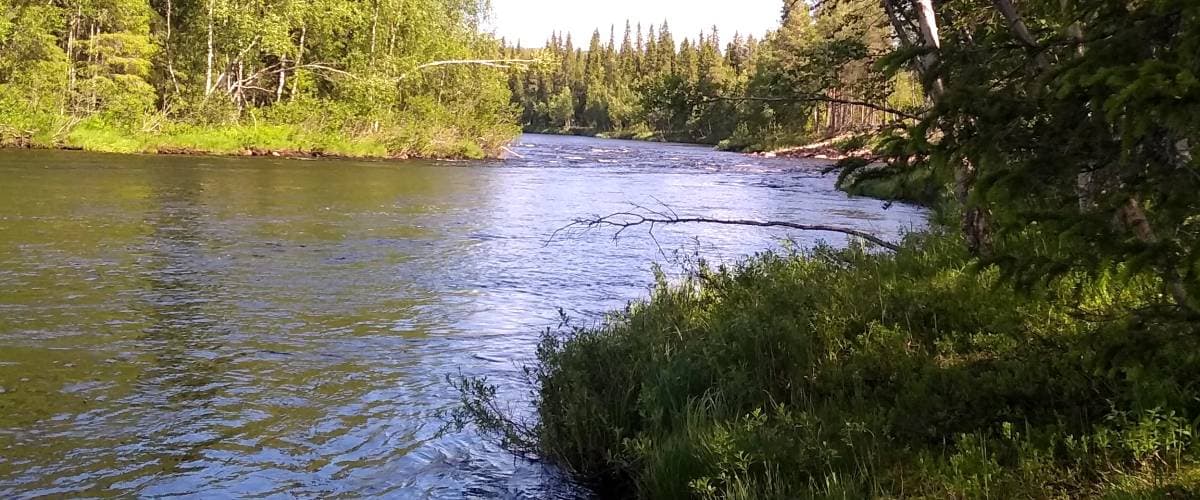
Lina älv inom Dokkas
Lina älv inom Dokkas covers an approximately 20 km continuous stretch of fishing water on the southern side of Linaälven, within the Dokkas area. Its relevance for salmon is closely linked to Linafallet, where Linaälven meets Ängesån. For salmon-focused anglers, this fishing area is best understood through that connection: fish passage, spawning habitat restoration and annual migration conditions shape the real value of the water.
The area has a mixed salmonid profile. Grayling and trout are part of the regular fishing context, while salmon is linked to the fish passage at Linafallet, where the fish counter documents salmon passage through the ladder. This is not classic lower-river salmon water, but a salmon-bearing river stretch where water level, access, migration conditions and restored habitat define the fishing area.
River character and salmon context
The key reference point for this fishing area is Linafallet, where Linaälven meets Ängesån. Linafallet is described as Norrbotten’s highest waterfall, with a drop of around 16 metres. The fall marks an important natural and ecological point in the system, especially because fish-passage work has been carried out there.
In 2018–2019, fish conservation measures were completed at Linafallet, including upgrading and refurbishing the salmon ladder and restoring spawning beds. iFiske notes that salmon migration doubled in 2020 compared with previous years, while the county fish counter at Linafallet documents salmon passage through the system. This gives Lina älv inom Dokkas a specific salmon context: it is a local river stretch connected to a restored migration route, not simply a mixed salmonid water.
Within the fishing area, the most relevant water for salmon and salmonids is likely to be found around current lines, deeper lies, necks, structured runs and sections connected with upstream movement. The salmon profile should therefore be understood through migration, habitat restoration and annual conditions rather than through the logic of classic lower-river salmon water.
Season, species and fishing expectations
The species profile is mixed but clearly salmonid-oriented. iFiske lists grayling, trout and salmon as possible catches in Lina älv inom Dokkas, with pike also mentioned as a possibility. The listed species support the view of a broader salmonid fishing area rather than a purely salmon-focused destination.
For salmon anglers, the main interest lies in the restored passage at Linafallet and what it means for fish moving through the system. Expectations depend on annual conditions, water level, migration timing and current local rules. This is a fishing area with salmon relevance, but not one that should be treated as guaranteed salmon water.
Tactics and planning
Planning Lina älv inom Dokkas starts with understanding the stretch as a south-bank fishing area rather than access to the entire river. The approximately 20 km continuous section gives room to choose water, but access, bank conditions and current level should guide the session.
For salmonids, the most relevant features are current lines, depth changes, holding lies and stretches connected with upstream movement. In higher water, control and safe positioning matter more. In lower water, careful presentation, quieter movement and selective coverage become more important. Grayling and trout may shape many regular sessions, while salmon remains the key migratory-fish context.
Essential formal notes
A valid licence is required for Lina älv inom Dokkas. Current licence conditions, dates, method rules, species-specific regulations and any local restrictions should always be checked before fishing.
This overview does not replace the current regulations. Full licence conditions, prices, dates, method rules and reporting requirements should be checked on the dedicated licence and regulations page.
Final assessment
Lina älv inom Dokkas is best understood as a salmon-bearing fishing area linked to the restored migration route at Linafallet. Its value lies in the combination of an approximately 20 km south-bank river stretch, a broader salmonid profile and the ecological importance of the Linafallet fish ladder.
This fishing area is most relevant for anglers interested in Linaälven as part of the wider Ängesån system, where restored fish passage, spawning habitat and annual migration conditions shape the real potential of the water. It should be approached as a salmon-relevant river stretch with a strong salmonid context, not as a classic lower-river salmon destination.