

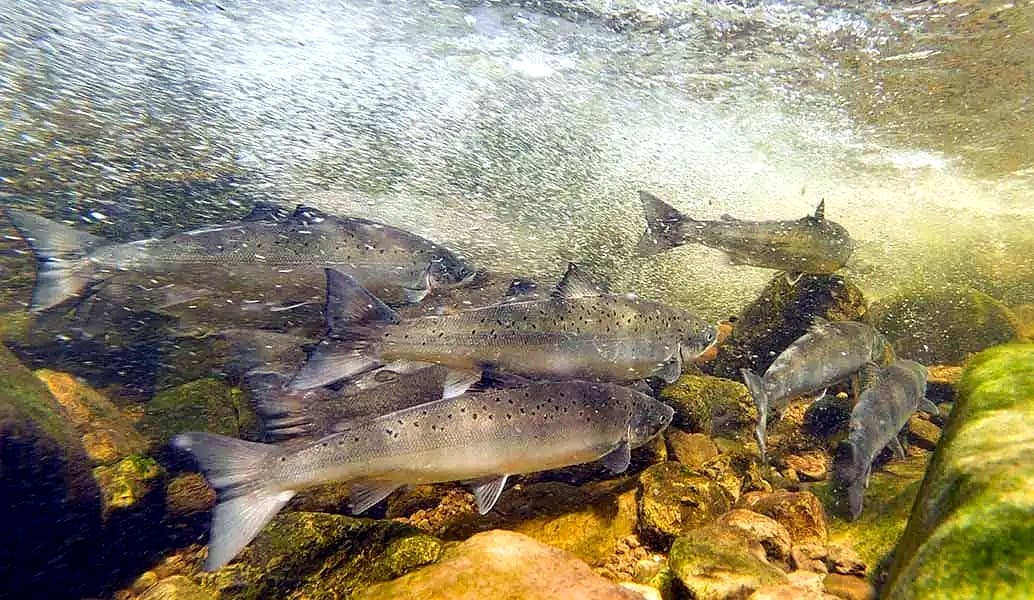
Why are fewer salmon returning to rivers? What we know after the 2023–2024 seasons
Wild salmon in many Gulf of Bothnia rivers recovered strongly after the crisis of the 1990s, but the 2023 and 2024 seasons have raised new concerns. According to SLU, the number of adult salmon returning to spawn in several Gulf of Bothnia rivers has decreased sharply since 2023, even though sea fishing pressure has remained low.
For anglers, this matters because returning adult salmon are one of the main signals that shape the river season. They are reflected in fish counter data, catch reports and local expectations, and they may also influence future management decisions. The situation is not the same in every river, but it is serious enough to follow closely.
Quick take
- Adult salmon returns were weak in several Baltic salmon rivers in 2023 and 2024, especially in some northern systems.
- The decline was especially clear in rivers such as Torneälven and Råneälven.
- SLU points to reduced survival at sea as the likely broad explanation, but the exact causes are still unclear.
- The situation varies between rivers, so one general answer for all Baltic salmon rivers would be too simple.
- For anglers, river-specific data matters more than general headlines.
In simple terms: fewer adult salmon returning to rivers does not automatically mean that a river has stopped producing young salmon. It may also mean that fewer fish survive after leaving freshwater and entering the Baltic Sea.
What happened in 2023 and 2024?
In 2023 and 2024, several Baltic salmon rivers had weak spawning migrations. Spawning migration means the movement of adult salmon from the sea back into rivers, where they reproduce.
This is the part of the salmon life cycle that anglers notice most directly. If fewer adult fish enter a river, there may be fewer fresh fish in the pools, fewer confirmed catches and weaker fish counter numbers.
SLU states that weak migration in several rivers during 2023 and 2024 has caused concern among researchers. The issue is not only that the numbers were low, but that they dropped despite already reduced sea fisheries.
That distinction is important. If fishing pressure at sea is low, but fewer salmon still return, the problem may be linked to another part of the salmon life cycle.
Was the decline the same in every river?
No. The pattern was not identical across all Baltic salmon rivers.
SLU explains that the situation varies between rivers. In the northernmost rivers, including Torneälven and Råneälven, spawning migration was significantly weaker in 2023 and 2024 than in previous years. Further south, the picture was more mixed: some rivers had weak migration, while others were closer to a normal year.
This is one of the most important points for anglers. A broad statement such as “Baltic salmon are doing badly” does not tell you enough about a specific river. Torneälven, Byskeälven, Mörrumsån and Ätran should not be treated as the same system.
Each river has its own conditions, population structure and fishing pressure. For trip planning, the useful question is not only “How are Baltic salmon doing?”, but also “What is happening in the river I want to fish?”
Why might fewer salmon be returning?
SLU suggests that the reduced migration appears to be linked to lower survival during the salmon’s time at sea. In simple terms, fewer salmon may be surviving the marine part of their life before they return to rivers as adults.
The exact reason is still unclear. Researchers are looking at several possible factors, including food availability, predation and the indirect effects of fishing for other species. These should be treated as research directions, not confirmed single causes.
This means the answer should remain cautious. It is too early to say that one factor explains the weak returns. A more accurate conclusion is that the marine phase of the salmon life cycle has become a key area of concern.
Why the sea phase matters
Salmon spend only part of their lives in rivers. Young salmon grow in freshwater, then migrate to the sea as smolts. A smolt is a young salmon that has changed physically and is ready to live in saltwater.
After entering the Baltic Sea, salmon feed and grow. Later, surviving adults return to their home rivers to spawn. If survival at sea drops, fewer adults come back, even if the river still produces young fish.
That is why a river can show two different signals at the same time. It may still have juvenile salmon in the system, but adult returns can be weak because too many fish are lost during the sea phase.
Important context: ICES estimated total wild salmon smolt production in Baltic rivers at about 2.9 million smolts in 2024, around 85% of the overall potential production capacity. This supports the idea that the issue is not only about river reproduction. The problem may also involve what happens after smolts leave freshwater.
For anglers, the effect appears later. A problem at sea may show up as fewer fresh fish entering the river, weaker seasonal reports and less predictable fishing.
Is this a temporary dip or a long-term warning?
SLU makes an important distinction. If the weak migration is only a temporary dip in sea survival, the situation may be less severe. There are still relatively large numbers of juvenile salmon in the rivers, and previous experience shows that stocks can recover after disturbances such as disease outbreaks.
The more serious scenario would be a longer-lasting decline in sea survival. If survival at sea remains low for several years, SLU expects this to lead to much lower salmon abundance both in the sea and in rivers. In that case, stronger restrictions on salmon fishing and possibly other measures may be needed.
So the key question is not only what happened in 2023 and 2024. The real question is whether these seasons were a short-term drop or the start of a longer pattern.
Why each river stock matters
Baltic salmon should not be seen as one single, uniform population. SLU explains that Baltic salmon consist of many genetically unique stocks. In practice, each river has its own genetically distinct salmon population.
This matters for both management and fishing expectations. A strong river does not automatically mean that all Baltic salmon are doing well. A weak river should also not be judged only by data from another system.
For anglers, this has a simple consequence: general Baltic salmon news gives useful background, but the final decision should be based on the river they actually want to fish.
That means checking river-level data, not only regional summaries.
What should anglers check before a trip?
After weak migration years, old reputation is not enough. A famous river can still have a poor season, while a less obvious river may sometimes offer better current conditions. This is not a rule, but it is a useful reminder: reputation should not replace fresh data.
Before planning a salmon trip, check:
- recent fish counter data, if available,
- latest catch reports from the river or fishery,
- water level and recent flow trend,
- water temperature,
- local restrictions and season changes,
- whether reports refer to the whole river or only one section,
- how the current season compares with earlier years.
A weak regional trend does not automatically mean that a specific trip is pointless. But it does mean the decision should be based on fresh, river-specific information rather than assumptions from previous seasons.
What do researchers still not know?
Researchers still do not know exactly why sea survival has declined. SLU has started a research project on behalf of the Swedish Agency for Marine and Water Management to investigate the issue. The first results are expected by the end of 2025 or early 2026.
The project is looking at existing data on factors that may affect survival during the sea phase. These include salmon food availability, predation and possible effects linked to fisheries for other species.
For now, the safest conclusion is this: the 2023–2024 seasons point to the marine part of the salmon life cycle as a key area of concern, but the exact mechanism is still being studied.
What this means for salmon anglers
For anglers, the main lesson is practical: reputation is not enough after weak migration years. River choice should be based on current migration signals, water conditions, fresh reports and local rules.
A famous river can still have a difficult season, while another system may offer better current conditions. In years with uncertain salmon returns, the best decisions are not based on one headline. They are based on several signals read together.
FAQ
SLU suggests that the reduced migration is probably linked to lower survival at sea. The exact reasons are still unclear, and researchers are analysing several possible factors, including food availability, predation and effects connected with fisheries for other species.Were all Baltic salmon rivers affected in the same way?